

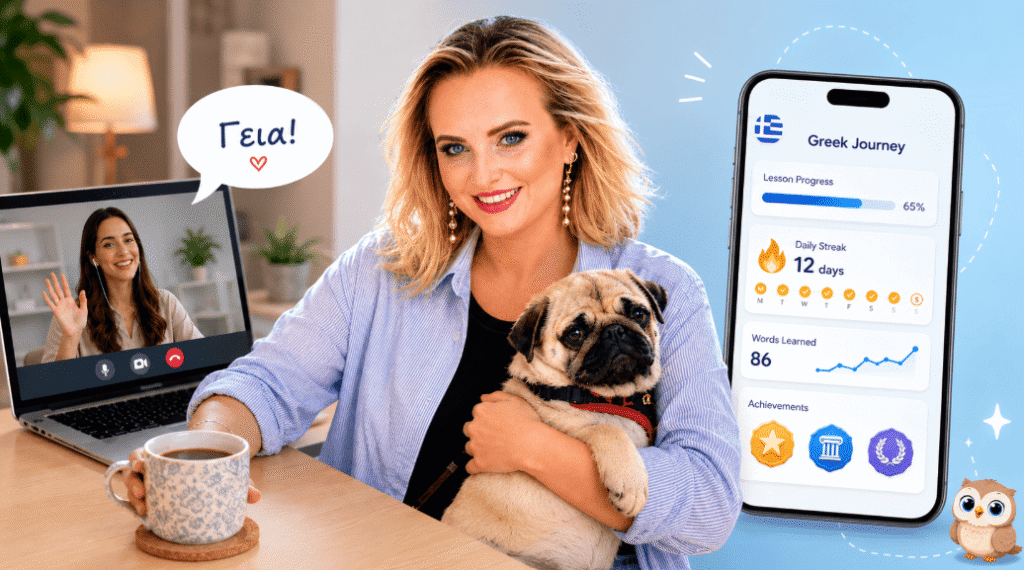
I have a Master’s degree in Linguistics and Cultures, eight languages under my belt, and enough hours on language apps to qualify as a part-time employee. And I still had to learn the same lesson twice: technology can teach you a language. Only a human can teach you to speak it.
By the age of 45, I had learned enough languages to believe I understood the process. German got me into university. English became my working language. Turkish helped me understand a culture from the inside. I’d picked up Italian, French, Spanish, and scattered pieces of others along the way.
I’ve lived in Ukraine, Germany, the UK, Malta, and Cyprus. I also enjoyed some wonderful language learning trips to Italy. Language learning, for me, wasn’t a mystery. It was a familiar project with a familiar shape.
So when my family and I decided to move to South Cyprus, I did what I always do: I started preparing months in advance. I wanted to be ready to integrate from day one, not to arrive and then start. I opened the apps, built the habit, and got to work. I was confident. I knew how this went.
What followed was one of the more humbling experiences of my adult life.
How I Learned Languages in 2002 Versus How I Learn Them Now
When I started studying English language and literature at Kyiv National Linguistic University, I was 18 years old, and language learning looked very different from what it does today. Textbooks from the 1980s that smelled like another era. CDs you had to rewind. Dictionaries you actually flipped through page by page. Evening classes where a teacher could see your face the moment you didn’t understand something, and would stop, rethink, and explain it differently.
Then came linguistic and cultural studies in Germany, and the story was the same, just updated. Modern textbooks this time, fresh notebooks, structured exercises, and long discussions about dialects, social context, and the way language actually lives inside a culture.

In 2026, I learn with AI tools, language apps, instant translation, YouTube channels, and podcasts I can pause and replay. I can access a native speaker explaining any grammar point within thirty seconds.
Technology has made language learning more accessible than at any point in history.
It has also made it easier than ever to avoid speaking to actual people.
That sounds like a small thing. It isn’t.
I Was Learning Greek Without Ever Feeling Uncomfortable
After months of daily app-based study, I had the stats to prove I was learning. Vocabulary ticked off, grammar patterns recognised, the alphabet cracked, a small collection of phrases I could deploy with confidence.
The little progress bars were very happy with me. I was less sure.
Something was off, and it took me embarrassingly long to figure out what.

The problem wasn’t that I didn’t know enough Greek. The problem was that I had been learning Greek in conditions that bear absolutely no resemblance to actual Greek life. Apps are endlessly patient. They don’t interrupt you mid-sentence. They don’t look mildly puzzled when you say something weird. They never mishear you, never go off-script, never ask a follow-up question you weren’t prepared for. Everything is smooth, manageable, and quietly designed so that you always feel fine.
Real life, as it turns out, does not care about your feelings.
My first real Greek conversation wasn’t with an app. It was with my tutor, a real person on the other side of a screen, who spoke at natural speed, went off-script immediately, and expected actual answers. After months of daily study, I sat there with a head full of Greek and absolutely no ability to use it.
Which is, if nothing else, a very efficient way to feel like an idiot.

After Years of Learning Alone, I Finally Booked a Tutor
I want to be honest about my resistance, because I think it’s common. I’ve always believed the best learning happens with a real teacher in a real room. Someone who can see your notebook, point at the line where you went wrong, feel the energy shift when you’re lost. Online tutoring always struck me as a pale substitute.

I also, if I’m being really honest, didn’t want to feel like a beginner. I have a linguistics degree. I speak eight languages. Sitting in front of a screen struggling through basic Greek sentences felt like it should be beneath me.
That particular flavour of pride is a very effective barrier to progress.
Eventually the gap between what I knew and what I could actually do became impossible to ignore. I found Preply, an online platform that matches you with language tutors from around the world, and signed up before I could talk myself out of it.

Choosing a tutor on Preply is its own psychological event.
The platform has what feels like a small nation’s worth of options, each with a profile photo carefully selected to project warmth, authority, or in a few memorable cases, the energy of someone who has consumed an alarming quantity of espresso before dawn. I watched more profile videos than I care to admit. I read reviews. I cross-referenced qualifications. At one point I had seven tabs open and was building what can only be described as a spreadsheet of human beings.
Then I found the filters.
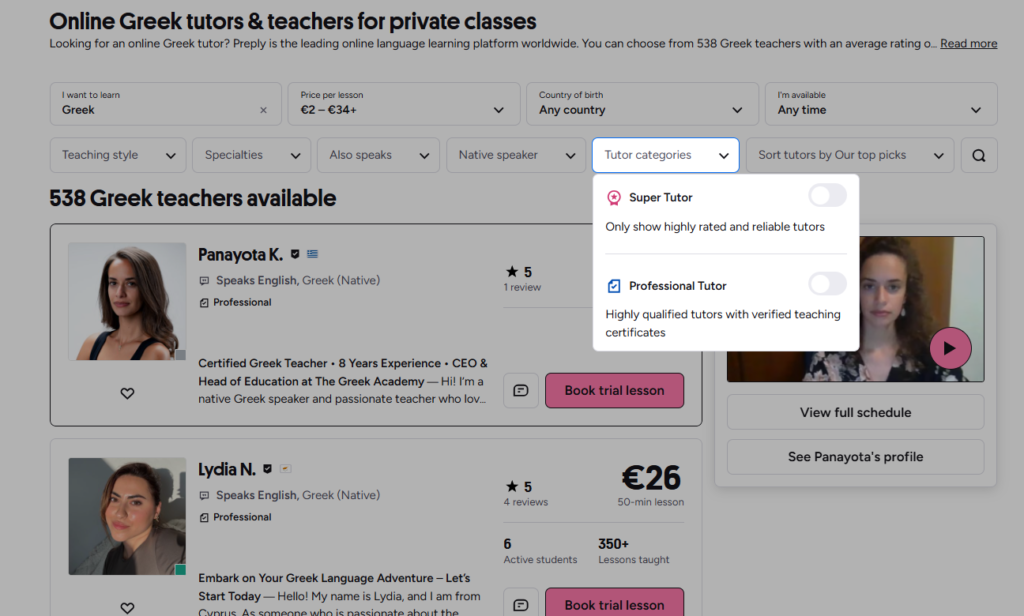
Preply lets you narrow things down by Super Tutors, people with a proven track record and reviews that suggest their students actually learned something, and Professional Tutors, who hold real teaching certificates rather than just a passionate belief that they can explain grammar. If you’re looking for more information about this filter, you can read about it here: “What is a Super Tutor?”.
This was useful! It’s the difference between browsing a menu and someone just pointing at the thing that won’t give you food poisoning.
I picked someone. Paid €25 for a trial lesson. Sat down at my kitchen table with tea, a notebook, and the stubborn skepticism of a person who has been burned by optimism before.
You can read about my full experience with the online tutoring platform Preply in this detailed review:
What Surprised Me Wasn't the Teaching
I expected methodology. A lesson plan… Clear explanations… Basically an app but with a face. What I got was someone who actually paid attention to me.
My tutor listened. Not in the polite, waiting-for-you-to-finish way, but listened, catching the exact sounds I was mangling, noticing the patterns I kept getting wrong, reacting with actual human curiosity when I said something unexpected. She wanted to know why I was learning Greek, what my life in South Cyprus was going to look like, what I actually needed the language to do for me. And then she taught me that, not the generic version.
For the first time in months, Greek stopped being a series of exercises on my phone and became something I was actually doing with another person.
That’s a small shift that changes everything.
The Hardest Part of Learning a Language Isn't Vocabulary
Here’s the thing nobody puts in the app store description.
I thought I had been diligently studying Greek for months. Building vocabulary, internalising grammar, making progress. And in a very narrow, very comfortable sense, I was. But what I was also doing, without fully admitting it to myself, was hiding. Inside a system that never once made me feel stupid. That never paused, looked at me, and waited. That never had the nerve to just sit there in silence while I frantically searched for a word I definitely learned three weeks ago and cannot now locate anywhere in my brain.
I have a linguistics degree. I know how language acquisition works. And I was still sitting there every morning completing my little exercises and feeling pleased with myself, like a person who trains exclusively on a stationary bike and then acts surprised when actual hills exist.
The real problem wasn’t knowledge. It was courage. Specifically, the courage to sound like an idiot in front of another human being. To make a mistake out loud, in real time, with someone watching. To open your mouth before you feel ready, which if you’re anything like me, would mean never opening it at all.
It’s a brilliant design feature.
It’s also, I’d argue, the single biggest reason you can spend years on a language app and still freeze completely the moment a real person asks you something.
That silence, it turns out, is exactly where the learning lives.
The Lesson Had Nothing to Do With Greek
Greek was just where I noticed it. But I don’t think this is actually about Greek.
We live in a world that has become extraordinarily good at making technology feel like enough. There’s an app for fitness, an app for therapy, an AI for career advice, a chatbot for loneliness. I use most of them. I’m not being sarcastic, they’re useful and I’m not about to pretend otherwise while typing this on my laptop at midnight with three AI tabs open.
But here’s what I kept coming back to after those first tutor sessions. During all those months of solo app learning, I wasn’t just missing conversation practice. I was missing the experience of being observed, responded to, and occasionally corrected by another human being who actually gave a damn whether I was getting it or not.
That’s a different thing entirely. And it’s quietly disappearing from more areas of life than just language learning.
We text instead of call because it’s less awkward. We ask AI instead of colleagues because it’s faster and nobody judges you for not knowing. We learn alone because it’s more convenient and nobody sees you struggle. All of this is completely understandable. Some of it is better. And some of it is just comfortable in a way that doesn’t serve us at all.
A personal trainer who notices your form is collapsing before you injure yourself. A therapist who catches the thing you didn’t say. A tutor who hears the exact sound you keep getting wrong and stops you right there. None of that is replicable by an algorithm yet. Not because the algorithms aren’t clever. Because presence is doing something that intelligence alone doesn’t cover.
The Balance I Finally Found
I still use language apps every day. I use AI, and trust me, it’s not going anywhere. Translation tools, grammar checkers, flashcards, vocabulary apps. I use all of it. If a piece of technology can save me time or make learning easier, I’m probably already using it.
And honestly, it all works.
Anyone who says language apps are useless has probably never tried learning a completely new alphabet at 45 while running an online content business, raising two children, managing a household, and trying to keep all the balls in the air.
The language apps helped me build a habit. AI helped me get answers instantly. Both made learning easier.
What they didn’t do was make me brave enough to speak. That part only started when another human being entered the picture.
But once a week, I close the apps and sit down with an actual human being and struggle through fifty minutes of Greek.
Yes, you read that right:the kind of struggle I had become very good at avoiding.

The kind where you lose a word halfway through a sentence and just have to sit there and find it while someone waits. The kind where you mispronounce something and get corrected and feel briefly like a small embarrassed potato.
Those fifty minutes do more for my Greek than everything else combined. Not because the technology is bad. Because learning was never supposed to be something you do entirely alone, in perfect comfort, with a cartoon owl cheering you on.
The discomfort is the point.
The other person is the point.
The moment when you absolutely cannot find the word and someone is waiting and somehow you find it anyway, that’s the whole thing right there. That’s where it actually happens.
In three weeks, my husband, our two sons, our pets, and I are moving to South Cyprus. I will not be fluent. I will be confused regularly, probably embarrassed occasionally, and almost certainly humbled by a language that has been around since before the concept of embarrassment was invented.
And honestly? I cannot wait.
For the first time in this whole process, the discomfort feels less like a problem and more like the actual destination.
Which, as it turns out, is exactly where learning begins.

If you enjoyed my article, please feel free to share it. Have any questions? Don't hesitate to email me!
Disclaimer: I select and review independently. If you buy through affiliate links, I may earn commissions that help support my testing at no extra cost to you. Please read my full disclosure for more information.
Join Our Newsletter
Sign up now to get the freshest updates on language learning and exclusive app deals delivered straight to your inbox!

